
Why Didn’t We Have Fire Ants in Middle Tennessee Back in the ’80s?

Kids who grew up in Middle Tennessee in the 1980s ran barefoot across yards and ballfields without a second thought about fire ants. Today, fire ants in Middle Tennessee are a fact of life, with mounds popping up in lawns, parks, and roadsides from Clarksville to Murfreesboro. They’re the next chapter in our series on pests that weren’t around when many of us were growing up, after stink bugs, Asian lady beetles, and kudzu bugs.
They started in a port in Alabama
Imported fire ants aren’t from here. Two species, the black imported fire ant and the red imported fire ant, came to the United States from South America through the port of Mobile, Alabama. The black imported fire ant arrived around 1918 and the red imported fire ant in the late 1930s, probably in soil used as ballast in cargo ships (USDA APHIS).
From there, they moved north and west. Fire ants can spread naturally by flying short distances, but long-distance spread happens mainly when people move infested materials like baled hay and straw, nursery plants, grass sod, soil, and equipment (Utah State University Extension).
When fire ants reached Tennessee
Fire ants took decades to reach Tennessee. The first confirmed sighting was an isolated infestation in Shelby County in 1948, which was quickly eradicated. Natural migration into the state wasn’t documented until 1987, in Hardin County along the Tennessee-Alabama-Mississippi line (Tennessee Department of Agriculture).
In other words, fire ants were just crossing the state line at the end of the 1980s, still more than 100 miles south of Nashville. Tennessee established its imported fire ant quarantine rule in 1990, and the state now surveys every year to track the ants’ northward migration (Tennessee Department of Agriculture).
Fire ants in Middle Tennessee today
Today, all or parts of 87 Tennessee counties are under fire ant quarantine (Tennessee Department of Agriculture). Middle Tennessee counties on the state’s quarantine list include Davidson, Williamson, Rutherford, and Robertson (Tennessee Department of Agriculture), and federal orders have extended the quarantine to all of Sumner, Montgomery, Cheatham, and Dickson counties, among others (USDA APHIS).
Middle Tennessee is also one of the few places where all three types live. The black imported fire ant has only been reported in Mississippi, Alabama, and Tennessee (Utah State University Extension), and the black and red species interbreed to produce a hybrid. Nationally, imported fire ants now infest more than 367 million acres across 14 states and Puerto Rico (USDA APHIS), and they’re still moving north. In 2022, they were found in several southern Kentucky counties (University of Kentucky Extension).
Fire ants are north of Nashville now, too
For years, a lot of people thought of fire ants as a problem south of Nashville, in Williamson and Rutherford counties. That’s no longer the case. Our technicians are finding fire ant mounds across Sumner County, in Hendersonville, Gallatin, and the surrounding area, and the official records back up what we’re seeing. A 2021 federal order extended the fire ant quarantine to all of Sumner County (USDA APHIS), and Robertson County, also north of Nashville, is on the state’s current quarantine list (Tennessee Department of Agriculture). Fire ants in Middle Tennessee are now on both sides of the Cumberland River.
How to identify fire ants
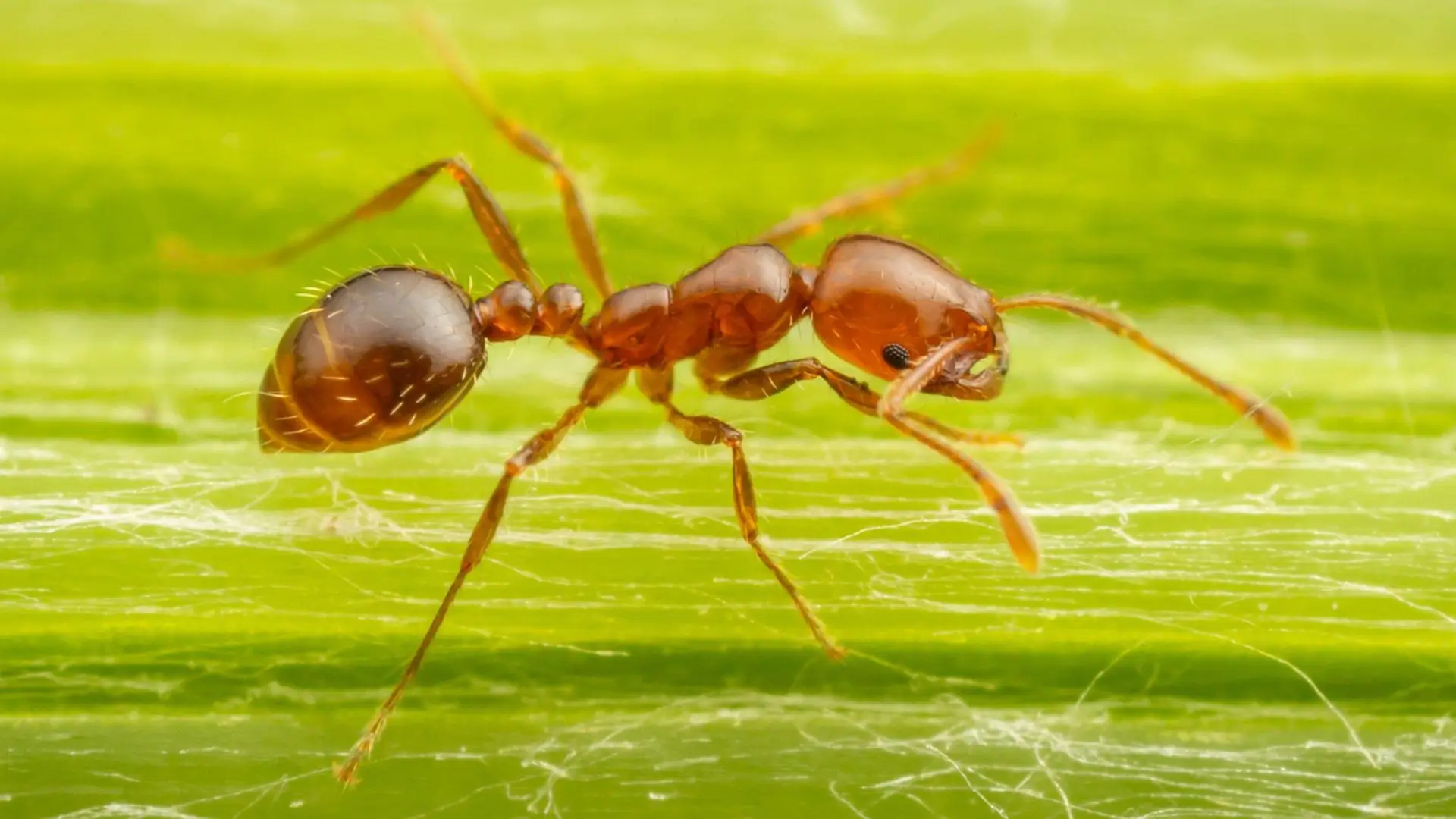
Fire ants look a lot like ordinary ants at first glance. Here’s how to tell them apart:
- Size and color. Fire ants average 1/8 to 1/4 inch long and are reddish-brown to black (National Park Service). Red imported fire ants are reddish-brown with a darker abdomen (Texas A&M AgriLife).
- Mixed sizes. Unlike most ants, a fire ant colony has workers of many different sizes (NC State Extension). If you see big and tiny ants coming out of the same mound, think fire ants.
- The mound. Fire ants build mounds in almost any soil, but prefer open, sunny areas like lawns, parks, pastures, and fields. The mound has no opening in the center like most ant mounds, because the ants come and go through underground tunnels (National Park Service). Mounds often show up after a rain.
- The behavior. Disturb a mound and the workers pour out and sting the intruder aggressively (National Park Service). Ordinary ants scatter; fire ants attack.
For photos and more detail, see our fire ant identification guide.
What a fire ant sting feels like
Every summer, we hear the same story from customers: someone steps into a mound while mowing, weeding, or standing at a ballfield, and within seconds feels dozens of burning stings racing up their legs. Over the next day, the stings turn into red, swollen, itchy bumps and blisters. Kids and pets often get it worst, because they don’t see the mound until they’re standing in it.
That pain has a reason. A fire ant first bites to grab hold of your skin with its jaws, then stings and injects venom (National Park Service). It can sting repeatedly, and the venom produces a fire-like burning sensation (Texas A&M AgriLife). Within about 24 hours, a fluid-filled pustule usually forms at each sting site, and scratching it open can lead to infection and scarring (NC State Extension).
Most people can tolerate fire ant stings, but some are hypersensitive and should be prepared for a medical emergency if stung (Texas A&M AgriLife). Fire ant stings can cause allergic reactions, including rare cases of life-threatening anaphylaxis (USDA APHIS).
If you get stung: move away from the mound and brush the ants off quickly, since they hold on while they sting. Wash the area with soap and water, use a cold compress for swelling, and don’t scratch or pop the blisters. Get emergency help right away for any signs of a severe allergic reaction, like trouble breathing, swelling of the face or throat, or dizziness.
How to avoid fire ant stings
- Walk the yard after rain. New mounds often appear after a soaking rain, so check lawns, play areas, and the edges of driveways and sidewalks.
- Don’t disturb a mound. Kicking or mowing over a mound sends ants swarming out to sting. Keep kids and pets away.
- Be careful what you bring home. Sod, soil, mulch, hay, and nursery plants can carry fire ants into new areas.
- Expect them after rain. Mounds often pop up after heavy rain. Here’s why you’re seeing more fire ant mounds in your yard.
How U.S. Pest helps
Store-bought mound treatments often just push fire ants to build a new mound a few feet away. Our ant control service targets fire ant colonies across your whole yard, not just the mound you can see. If fire ants have taken over your lawn or someone in your family has already been stung, call us. We’ll get out to you fast and get to work on them right away, so your family can enjoy the yard again. Call 615-590-1260 or schedule a free inspection.
Serving your area: Nashville · Hendersonville · Franklin · More Middle Tennessee pest news
FAQs
Were there fire ants in Middle Tennessee in the 1980s?
No. Fire ants came to the U.S. through Mobile, Alabama, and natural migration into Tennessee wasn’t documented until 1987, in Hardin County on the state’s southern border. They reached Middle Tennessee in the years that followed.
What do fire ants look like?
Fire ants are 1/8 to 1/4 inch long and reddish-brown to black, and a single colony has workers of many different sizes. Their mounds are in open, sunny areas and have no opening in the center. When a mound is disturbed, the ants swarm out and sting aggressively.
Are fire ants in Davidson and Sumner counties?
Yes. Davidson County is on the state’s imported fire ant quarantine list, and a 2021 federal order extended the quarantine to all of Sumner County. Fire ants are now found north and south of Nashville, including Williamson, Rutherford, and Robertson counties.
How did fire ants spread to Tennessee?
They spread north from Alabama naturally, by flying short distances, and much faster when people moved infested hay, sod, soil, nursery plants, and equipment.
What should I do if I get stung by fire ants?
Move away from the mound and brush the ants off quickly. Wash the stings with soap and water, use a cold compress for swelling, and don’t scratch or pop the blisters that form. Get emergency help right away for signs of a severe allergic reaction, like trouble breathing or swelling of the face or throat.
Are fire ant stings dangerous?
Fire ants sting repeatedly when disturbed. Most stings cause painful, itchy bumps, but they can cause allergic reactions, including rare cases of life-threatening anaphylaxis.
How do I get rid of fire ants in my yard?
Avoid disturbing mounds, keep kids and pets away, and be careful bringing in sod, soil, or plants. Professional treatment that targets colonies across the whole yard works better than treating one mound at a time.