Mosquito Control That Actually Works in Middle TN Humidity

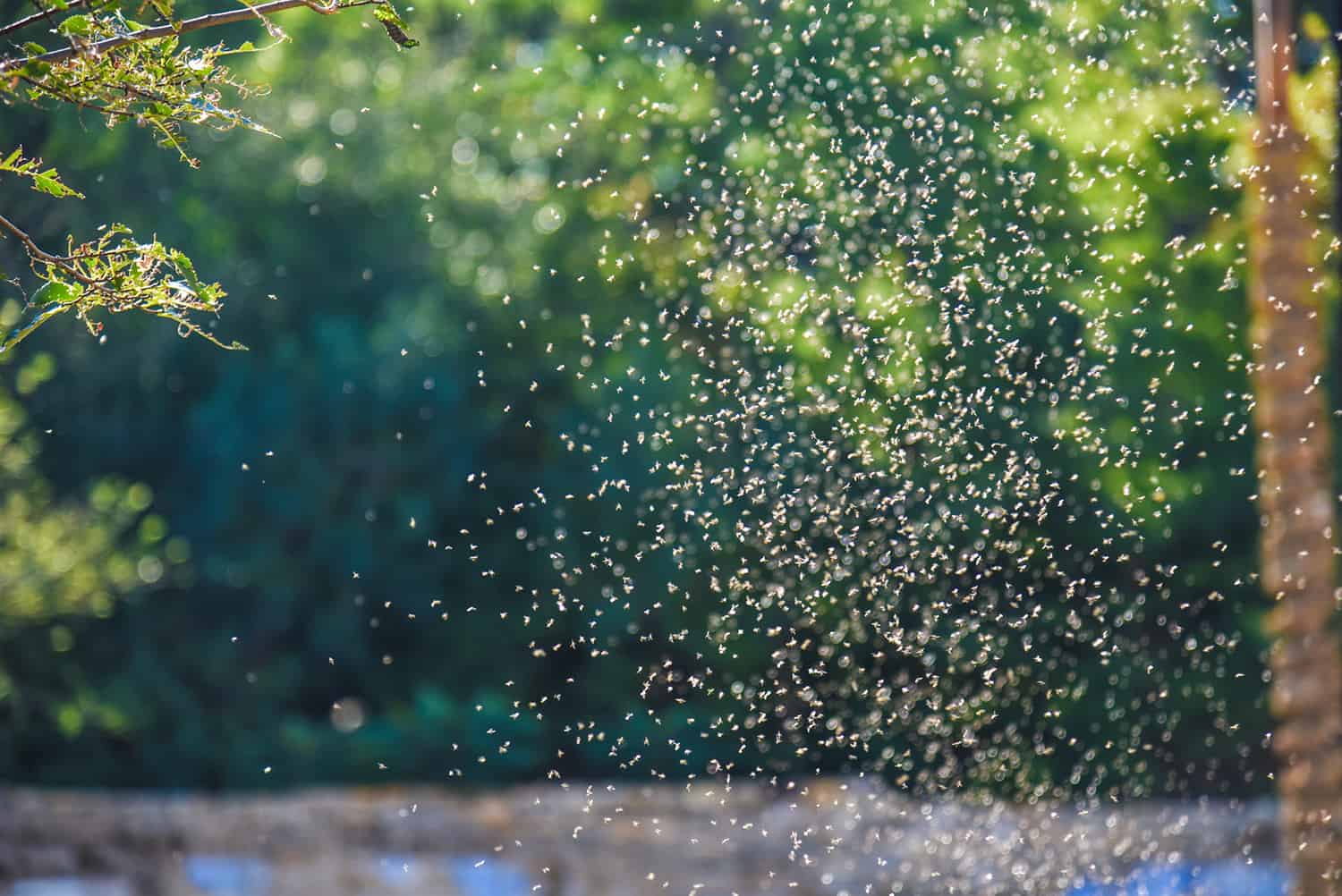
You spray, you swat, yet you still feel like you’re getting eaten alive by 7pm — don’t worry, you’re not crazy. Middle Tennessee humidity is crazy. The short version: our climate and soil recreate mosquito breeding conditions all season long, which means the single-product fixes that work elsewhere don’t hold up here. Real control takes a layered approach, and knowing why matters as much as knowing how.
Why Middle Tennessee Humidity Is Different
Tennessee’s landscape and location create a near-perfect setup for humidity. The state sits close enough to the Gulf of Mexico for prevailing winds to carry warm, saturated air north across the region. Summer rainfall is heavy, and dew points regularly climb into the upper 60s and 70s. Add in Middle Tennessee’s valleys, dense tree cover, and thick vegetation — which pump large amounts of water vapor into the air while blocking the breezes that would normally disperse it — and moisture just sits.
That moisture doesn’t arrive steadily, either. Middle Tennessee tends to swing between drought and downpour, and this year has been an especially sharp example: from mid-2025 through June 2026, the region logged eight consecutive months of below-average rainfall. Then, in July, that deficit reversed — more than six inches of rain fell in a multi-week stretch, over double the typical monthly average.
Here’s the part most homeowners don’t expect: dry spells don’t kill mosquito eggs the way people assume. Floodwater mosquito species are built to survive drought — their eggs lie dormant in dry soil and containers, sometimes for months. When heavy rain finally arrives, standing water fills back in and triggers a synchronized hatch within four to seven days, producing a sudden spike in the mosquito population.
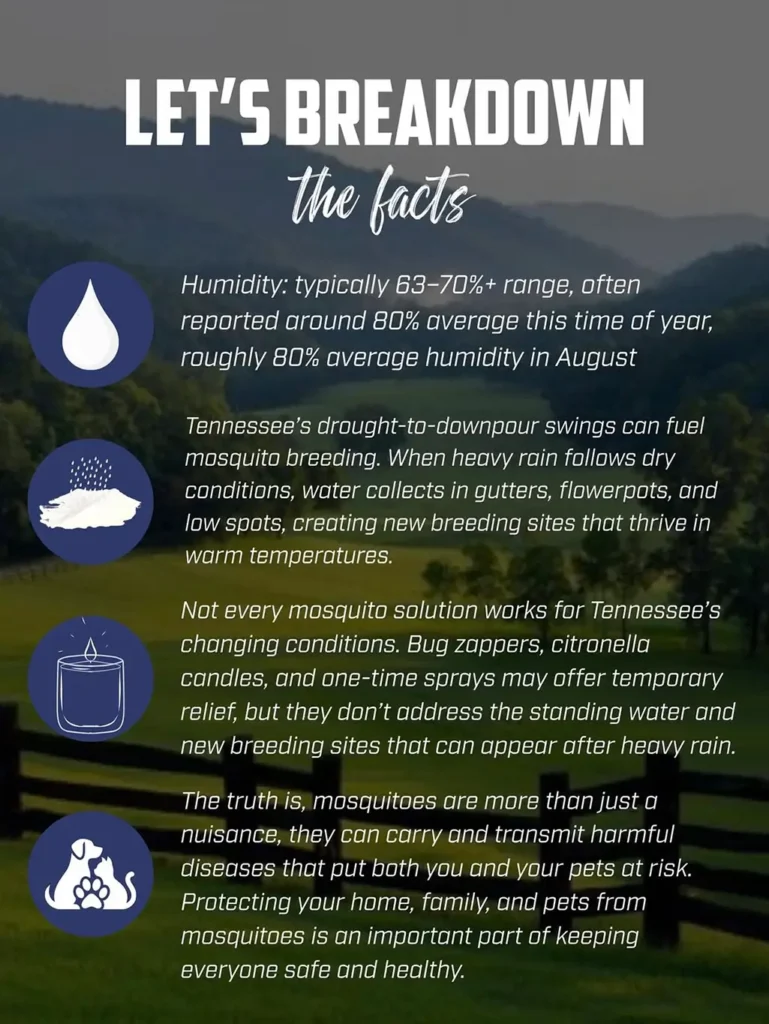
Middle Tennessee’s dense, compact red and yellow clay soils make this worse. Clay absorbs rainfall slowly, so instead of draining, water pools in low spots or runs toward home foundations, leaving damp yards and standing water long after a storm has passed. Between the drought-to-downpour cycle and the soil that holds onto every drop, this region gives mosquitoes ideal breeding grounds most of the year. That’s why generic mosquito advice — built for drier, flatter climates — doesn’t hold up here.
Why General Advice Fails
You’ve probably tried the standard remedies: bug zappers, citronella candles, ultrasonic devices, one-time yard sprays. Some of these don’t just fail to help — they can make the problem worse.
Bug Zappers
A 10-week University of Delaware entomology study found that fewer than 0.25% of the roughly 13,000 insects killed by bug zappers were mosquitoes — the rest were beneficial insects like moths, beetles, and pollinators. Similar findings from the American Mosquito Control Association confirm zappers catch a negligible share of biting mosquitoes. Zappers can also draw more insects into your immediate area without lowering the biting population.
Ultrasonic Devices
Mosquitoes locate humans by tracking carbon dioxide, body heat, and sweat — not sound. They aren’t attracted to or repelled by high-pitched sound waves, which is why ultrasonic repellers have never been shown to meaningfully reduce mosquito activity.
Candles
Citronella candles rely on scent to mask the signals mosquitoes track, but most contain only a small percentage of actual citronella oil — not enough to override the heat and CO2 signature of a human body sitting nearby.
One-Time Sprays
A single spray only kills the adult mosquitoes it directly contacts. It does nothing to stop the eggs and larvae already waiting in standing water, and mosquitoes resting in cool, shaded areas are often missed entirely. Standard pyrethroid sprays also break down quickly in sunlight, heat, and rain — the protective residue can disappear within days or even hours, which is a large part of why DIY treatments feel like they stop working almost as soon as they start.
What Actually Works
Real mosquito control in this climate must interrupt every stage of the life cycle, not just knock down adults for a night. Three components make the difference:
1. Larviciding Standing Water
Targeted products are applied directly to standing water to kill mosquito larvae before they mature into biting adults, cutting the population off before it starts rather than chasing it after the fact.
2. Recurring Treatment Cadence
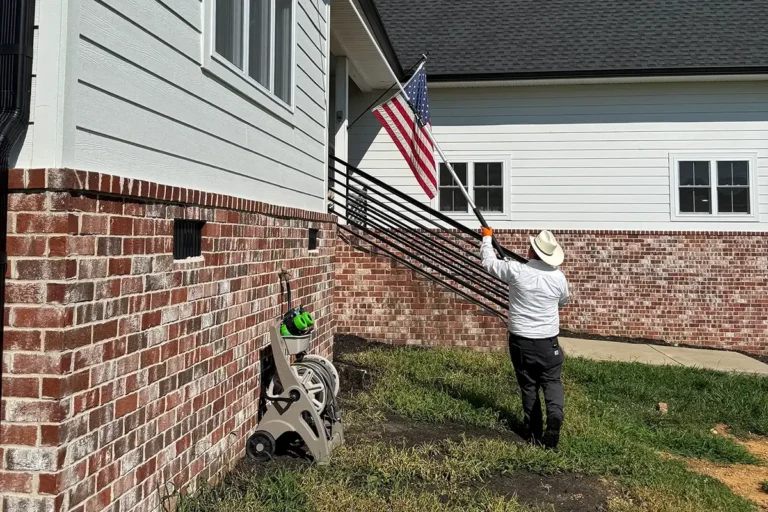
Residual insecticides are applied to lower tree foliage, shrubs, and fence lines — the shaded areas where adult mosquitoes rest during the day. These treatments are typically reapplied on a 14-30 day cadence, timed to break the mosquito life cycle as new generations emerge, rather than treating once and hoping it holds.
3. Vegetation Management
Routine yard maintenance — clearing leaf litter, trimming shrubs and bushes, mowing regularly — eliminates the shady resting spots adult mosquitoes rely on between feedings.
DIY vs. Professional Treatment
| DIY Approach | Professional Treatment (U.S. Pest) | |
|---|---|---|
| Targets | Adult mosquitoes present at time of spraying | Eggs, larvae, and adults in every life stage |
| Duration | Hours to a few days | 14–30 day residual protection, reapplied on cadence |
| Breeding Sites | Only what you can see and reach | Identifies hidden and hard-to-reach standing water |
| Best For | Light activity, small yards, in-between upkeep | Consistent, season-long population reduction and elimination |
What You Can Do Yourself
These steps genuinely help and are worth doing regardless of whether you also treat professionally:
- Clear standing water from pots, bird baths, buckets, toys, and anything else that can hold water — mosquitoes can breed in as little as a bottle cap’s worth
- Keep up with yard maintenance: mow regularly, trim bushes, and clear leaf litter
- Run fans outdoors — mosquitoes are weak fliers and struggle against moving air
- Keep natural plants like basil, rosemary, and catnip near seating areas as a mild deterrent
When DIY Isn’t Enough
At-home treatments help, but truly reducing mosquito populations in Middle Tennessee’s climate is difficult without professional support. U.S. Pest’s 12-month treatment plan targets mosquitoes at every stage of the life cycle, year-round. Consistency matters — missing even one stage of treatment can undo progress made heading into the next high season.
If family members are getting bitten frequently despite taking precautions, or if your property has ornamental ponds, water features, or heavily wooded areas that create ideal breeding conditions, professional treatment is worth it. Call U.S. Pest at 615.590.1260 or schedule a free inspection to get started.
Mosquitoes and Health Risk in Middle Tennessee
Beyond the nuisance factor, mosquitoes here can transmit disease — most notably West Nile virus, the most common mosquito-borne illness in Middle Tennessee. According to the Tennessee Department of Health, about 1 in 5 people infected develop fever, headache, body aches, joint pain, vomiting, diarrhea, or rash, and most recover fully. Less than 1% develop meningitis or encephalitis, and about 1 in 10 of those cases are fatal. People over 60 and those with underlying medical conditions face the greatest risk. No specific treatment or vaccine currently exists.
U.S. Pest Protection is a pest control company, not a medical provider. Our goal is to inform, not diagnose. If you’re experiencing symptoms of mosquito-borne illness, please seek medical attention.
Frequently Asked Questions
Does rain wash away mosquito treatment?
Not once it’s had time to bond. As long as a treatment has 30–60 minutes to dry on plants and surfaces, rain won’t wash it away — which is why treatments are scheduled for days forecasted to be dry and sunny.
How often should treatment happen in a humid environment?
During peak season, every 14–21 days. High humidity accelerates the mosquito life cycle and increases activity, so a standard 30-day treatment often wears off before the next application would occur. Exact frequency varies by yard and season, but 21 days is the industry-standard baseline.
Is professional mosquito treatment safe for pets and kids?
U.S. Pest uses eco-friendly, low-toxicity treatments designed to be tough on mosquitoes and gentler on your family.
Why do I still get bitten after treating my yard myself?
DIY sprays only kill the adult mosquitoes present at the moment of application. They don’t reach mosquitoes in hiding, don’t stop new eggs from hatching, and don’t prevent mosquitoes from neighboring yards from moving in.
How long until I notice a difference after treatment?
Most homeowners notice a difference within 24–48 hours:
- Hours 1–3: Adult mosquitoes in direct contact with the treatment die almost instantly
- Hours 3–4: The treatment binds and dries — mosquitoes that land to rest die from residual contact
- Days 2–21: Visible population decline continues as remaining adults die off and fewer new eggs hatch
Get Mosquito Control Built for Middle Tennessee
Generic advice doesn’t account for our humidity, our soil, or our rainfall swings — our treatment plans do. Call U.S. Pest Protection at 615.590.1260 or schedule a free inspection today.
This is not medical advice. U.S. Pest Protection is a pest control company, not a medical provider. The information here is general and descriptive. If you have symptoms after a mosquito bite, contact your physician. Our services reduce mosquitoes on your property — they do not prevent or treat illness.