

Fire Ants in Tennessee: What Homeowners Should Know

As temperatures cool into the 70s and below, fire ant mounds start appearing in yards across Middle Tennessee. Worker ants come to the surface to forage and collect food and nutrients before the colony goes deeper underground for winter. Mounds pop up in inconvenient places — lawns, driveways, public green spaces — and stepping on one is something you really want to avoid.
What Kind of Fire Ants Live in Tennessee?
There are three kinds of fire ants in Tennessee: the red imported fire ant, the black imported fire ant, and a hybrid of the two. The red fire ant is the most common in Middle Tennessee, but all three types have been reported in roughly 75 out of 95 counties in the state.
Fire ants were accidentally introduced to North America when ships from South America brought them into Mobile, Alabama. All three types share the same aggressive behaviors and painful defenses, but there are some differences worth knowing.
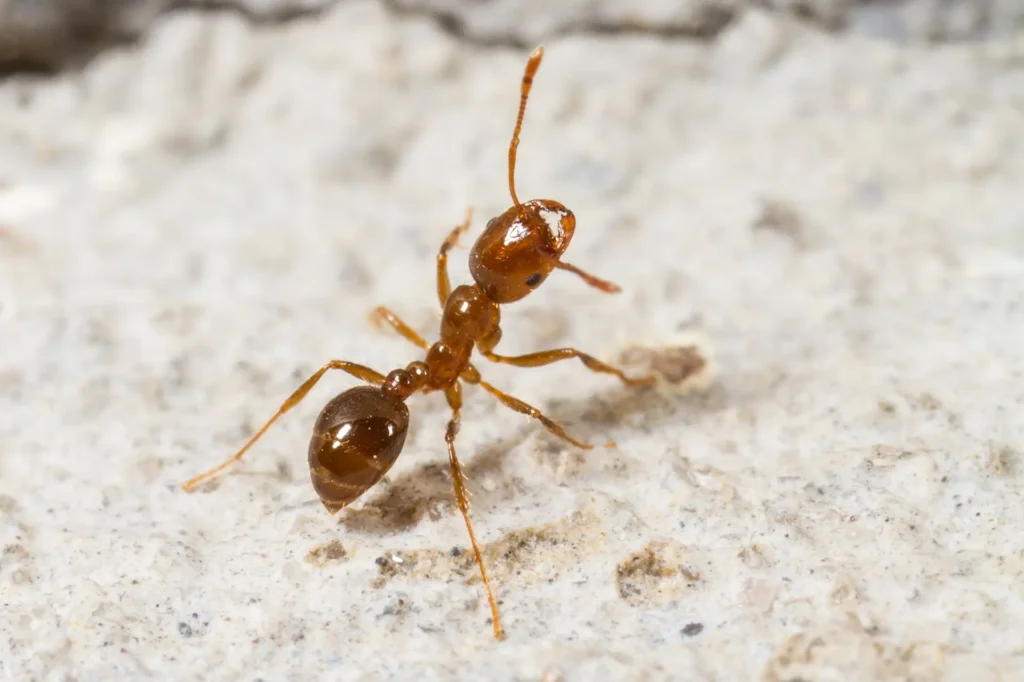
- Red imported fire ants are the most widespread. They’re reddish-brown with a darker abdomen, and their sting causes a severe burning sensation.
- Black imported fire ants are dark brown or black with two distinct gold patches on the abdomen. Stings from females can result in fluid-filled blisters and pustules.
- Hybrid fire ants are most common in East Tennessee and the hardiest of the three species — they can withstand colder weather more easily than the others and deliver a painful, venomous sting.
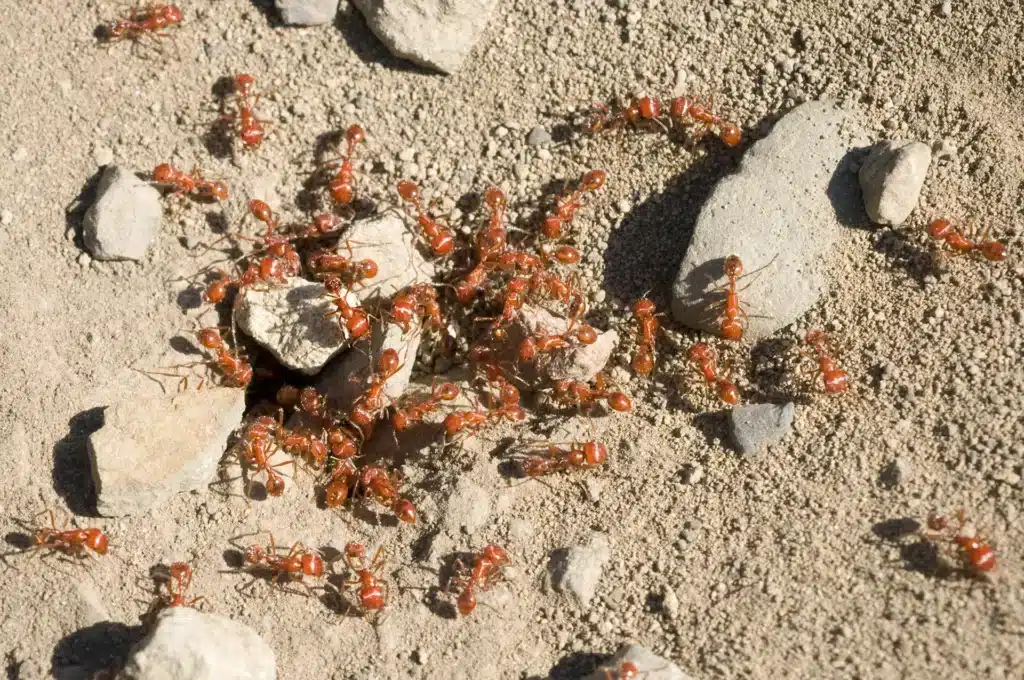
While coloring differs, all three species are similar in size, ranging from 1/16 to 1/4 of an inch. Ants in the same colony can vary in size, so if you see both large and small ants coming from the same mound, it’s likely a fire ant colony. They also build identical nests, which means you can’t tell which species you’re dealing with until you see the ants themselves.
What Do Fire Ant Mounds Look Like?
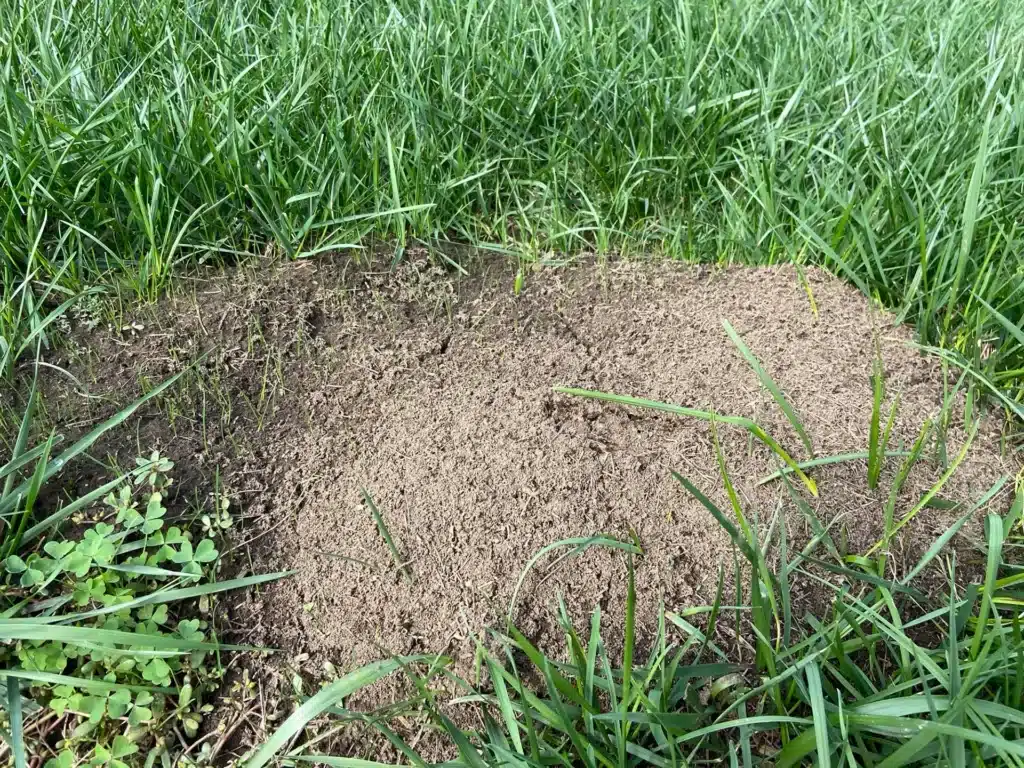
Fire ant mounds are usually easy to spot. Unlike native ants that build neat circles with a clear hole in the middle, fire ant mounds are solid domes with no opening on top. Fire ants travel in and out through underground tunnels around the base of the mound instead.
From above, the mounds look like piles of freshly tilled, fine crumbly dirt — almost like sand. They can range from 10 to 24 inches in diameter and reach 18 inches tall, depending on how long the colony has been there and what kind of soil it’s built in.
Fire ants don’t always build the domes they’re known for. They also nest in structures like sidewalks, driveways, and home foundations, and they’re drawn to utility boxes — electrical boxes, air conditioning units — because of the warmth those surfaces provide. You may also find them in rotting logs or tree stumps.
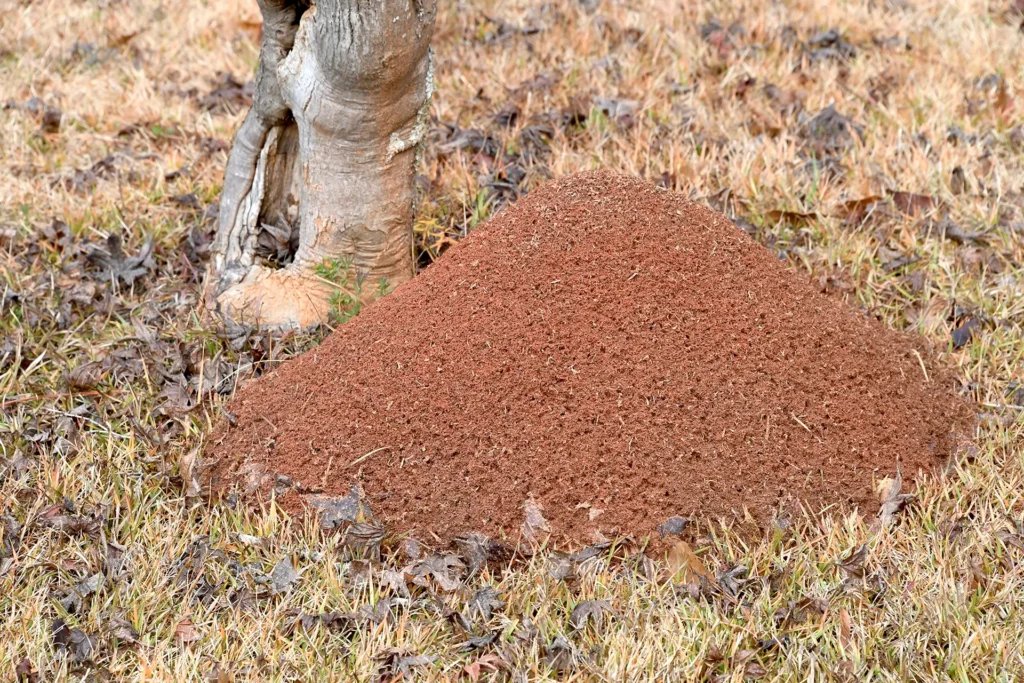
Most reports in Tennessee are for the typical dome nests in front lawns, backyards, and public green spaces where the soil stays warm. This puts people at regular risk of stepping on an unseen mound, which is a good reason to have your yard inspected before fire ant season peaks.
Why Am I Seeing So Many Fire Ants After It Rains?
Fire ants use deep underground tunnel networks. When it rains heavily, those tunnels flood, and worker ants push the queen and larvae upward through the soil to protect them. It can seem like a mound appeared overnight — or even within a few hours — because that’s essentially what happens. Wet soil makes it easy for worker ants to push the entire nest up to the surface, where the dome structure helps things dry out faster.
Warm, humid weather before rainfall also triggers mating swarms. Winged reproductive ants emerge in large numbers to start new colonies. Heavy rain also washes away the pheromone trails ants use to map territory and find their way back to the nest, which sends scout ants scattering to rebuild those trails — another reason fire ant activity looks chaotic after a storm.
Post-rainfall is actually the best time to treat for fire ants. The colony is close to the surface, and foraging ants are spread out collecting bait and granular treatments to carry straight back to the queen.
What Happens When a Fire Ant Stings?
Most stinging insects have water-soluble proteins and peptides in their venom. Fire ant venom is different — it’s made of oily, cell-destroying alkaloids similar in chemistry to laundry detergent, which causes direct local tissue damage and the immediate burning sensation fire ants are named for.
Many stings result in blistering and pustules, which is the body’s immune response to localized cell death. It may look like an infection, but the blisters are actually sterile — this is your body healing.
A single sting is painful, but that’s not what makes fire ants medically significant. They almost never attack alone. Disturb a mound and hundreds of ants swarm almost immediately. Each ant anchors in place and pivots around the sting site multiple times, meaning you can receive dozens of venom injections in a matter of seconds.

The proteins in fire ant venom contain allergens that trigger histamine release, intense itching, and in serious cases, severe allergic or anaphylactic reactions. Even without a severe reaction, expect itching, burning, and tiny blisters for several days — which is exactly why having your yard treated for fire ants is worth doing before you find them the hard way.
This article is for general information only and is not medical advice. If you or someone else experiences signs of a severe allergic reaction after a fire ant sting — including difficulty breathing, swelling of the face or throat, dizziness, or rapid heartbeat — call 911 immediately.
Why Should I Report Fire Ant Sightings?
Fire ants are an invasive species and reporting sightings helps the state track and slow their spread. Beyond the backyard nuisance, fire ants cause serious agricultural damage — costing billions of dollars annually in crop losses, livestock injuries, and equipment repairs.
Their underground tunnels uproot crops, chew on roots and stems of young plants, and damage trees. Fire ants also protect other plant-damaging insects they rely on, like aphids and mealybugs, and in some cases prey on ground-nesting animals and newborn livestock. Mature livestock avoids areas where mounds are built in fields, reducing usable grazing acreage. Large mounds that have dried and hardened in the sun can even damage mower blades and other equipment, and fire ants have been known to nest inside machinery — causing malfunctions and potential electrical fires.
Is Your Area Heavily Affected?
For years, fire ant reports were concentrated in the Nashville metro and areas to the south. Our technicians are now receiving calls and finding mounds north of Nashville as well, in Hendersonville, Gallatin, and the surrounding counties. Because fire ant activity has been expanding, it’s important to report sightings and address infestations promptly to help keep populations under control.
How U.S. Pest Protection Can Help
DIY treatments can help, but no home treatment is foolproof. At U.S. Pest Protection, we treat year-round to keep your home consistently protected. We offer free inspections, so if you’re seeing fire ant activity around your home or neighborhood, give us a call. We’ll find the mounds, build a plan, and get you on track to a pest-free yard. Call us today at 615.590.1260 or SCHEDULE ONLINE TODAY.