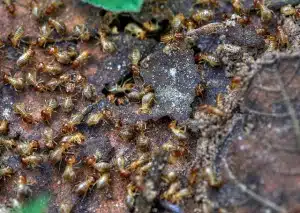
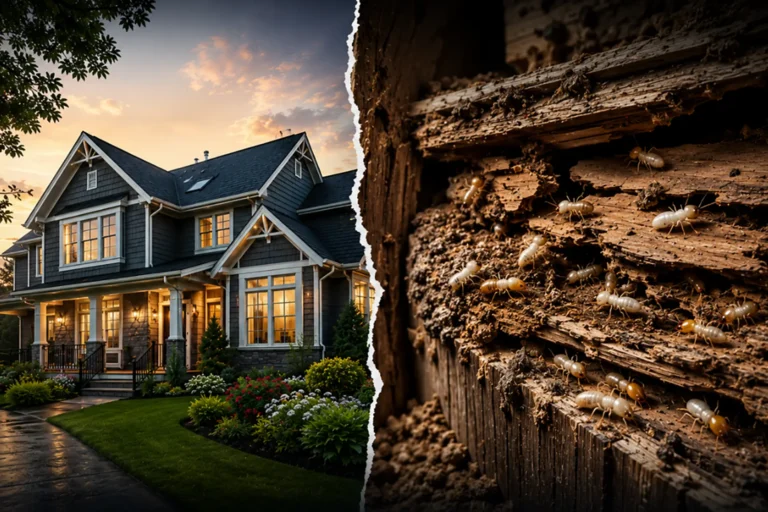
The termite is a destructive and pervasive insect that causes damage to upwards of 2 million homes each year. Of the over 2,600 species of termites found worldwide, 45 of them are found in the United States.
These insects eat cellulose found in decaying wood, cardboard, plant material, and even below grade foam board. Termites can cause irreversible damage to your home well before you become aware of their presence.
The Damage Caused by Termites
Though there are 3 types of termites, it is the subterranean variety that generates the most damage.
These termites hide in dark, damp areas that may be far away from their current “job site.” A colony can situate itself in a yard, crawl space, or up to 12 feet underground, living within tunnels that create a passageway to its work source – which may be your home.
How Termite Colonies are Organized
A colony of subterranean termites is similar to that of an ant colony. It has the same basic structure that includes:
a queen
workers
soldiers
winged reproducers
The reproducer termite would usually be the only one you would see out in the open. The others are busy working or hidden from view.
Identifying Reproducer Termites
At first glance, the reproductive termite may resemble a flying ant. However, there are three basic areas of distinction. The first are the wings. Termites have a set of four wings that are all the same in size and shape. An ant has four wings, but the forward and rear sets are very different.
Second, the body of the termite is a tubular shape, and the ant has a “pinched” waist. Lastly, an ant has a noticeable bend in its antenna and the termite’s is straight.
It is wise to discern these winged termites as a swarm of them, which usually happens once a year in the spring or early summer, because it is an indication that a colony may exist on your property, and, or a new one may be formed.
A swarm may consist of up to thousands of reproductive termites. It usually takes less than a few hours for the termites to swarm, mate, and find a location for the new colony. However, you may never see an actual swarm because an existing colony may take as much as three years to congregate reproductive termites before they go out to establish a new colony.
Signs Your Home May Be Infested with Termites
The termites that infest a home would be hidden in whatever wood that is being consumed as they devour it from the inside. If you knock on a piece of solid wood material and it sounds hollow, it’s a good sign you may have termites.
You may notice sawdust-like remnants, or even tiny pellets of sawdust, that have been left behind. Discarded wings from the reproducer termites are sometimes found. Any of these signs are reason for immediate investigation. All areas that are dark, perhaps decaying, poorly ventilated, or are in contact with moisture are of concern.
Need Help Killing Termites?
Termites have a place in a balanced ecosystem. In some environments they fulfill a vital role in the consumption of decaying plant material and recycling the nutrients back into nature. However, in your home they have a devastating effect.
There are specific steps that you can take to alleviate the potential for a termite infestation, and there are essential remedies that will fight existing colonies.
If you already have damage to your property, you need to choose the best termite protection company that can assist you in ridding your home of these insects and keep replacement material costs to a minimum.
U.S. Pest offers our customers the best possible termite protection available. Give us a call today at (615) 590-1260 to learn more.
Erica Brister is President & CEO of U.S. Pest Protection, a family- and female-owned company that has protected Middle Tennessee homes and businesses since 1985. She was appointed to the Tennessee Pest Control Advisory Board, and she leads a company built on a simple idea: pest control is a people business. Under her leadership, U.S. Pest's state-certified Pest Pros, who average more than seven years with the company, back every service with the Whatever It Takes Guarantee. Erica writes about the pests Tennessee families and businesses actually face, and the practical steps that keep them out.
How Do Pests Get Into Your Crawlspace – The crawlspace for many is a forgotten part of the home. Even though it is extra space, its an area that you cannot store anything and should not be hanging out in. So, for many they just do not think about. Unfortunately, if you do not maintain…
How often should I get my home inspected for termites? – Termites are one of the most destructive pests in the world, if undetected they can destroy your home in just a matter of years. That is why it is so important to stay ahead and have regular termite inspections every year. This way termites…
Many consumers are now turning to environmentally friendly household products and organic gardening, and are also looking for ways to control household and garden pests naturally. The Integrated Pest Management (IPM) techniques employed by the agricultural industry also focus on reducing the need for toxic chemicals. The foundation of IPM can also be the foundation of any…
Termites are among the most annoying and costly pests that can invade your home. They cause more damage than ants, cockroaches, and rodents combined, and multiply at least as quickly.
Every homeowner hopes they’ll never have to deal with termites. But hope isn’t a strategy — and in Middle Tennessee, where subterranean termites thrive in the warm, humid soil, the odds aren’t in your favor without some kind of protection in place. Here’s the part that catches most people off guard: the termites themselves are…
Performing termite inspections is something all homeowners should do. The professional inspection of your home before putting the structure under coverage is of the utmost importance. We will thoroughly inspect the appropriate areas and in doing so, we will also be able to inform you of issues we may find that are not termite related….