

Termites in Tennessee | Pest ID Guide
Quick Facts About Termites in Tennessee
Termites are the most expensive pest a Tennessee homeowner can face. They eat the wood inside your walls, floors, and crawl space, usually for years before anyone notices. Nearly every termite problem in Middle Tennessee comes from one group: subterranean termites.- Most common in Tennessee: Eastern subterranean termite, which lives in the soil and builds mud tubes
- Size: About 1/8 to 3/8 inch; winged swarmers are slightly larger
- Color: Creamy white workers; dark brown to black swarmers
- Active season: Feeding year-round; swarms usually appear from late winter through spring
- Colony size: Mature colonies can number in the hundreds of thousands
- Biggest risk: Hidden structural damage that insurance generally doesn’t cover

Types of Termites Found in Tennessee
Not all termites are equally likely here. This is how the main types compare in Tennessee.Subterranean Termites: The Main Threat
Subterranean termites nest in the soil and travel into homes through pencil-width mud tubes. Tennessee’s humid climate and moist soil suit them perfectly, and they are responsible for the vast majority of termite damage in the state. If you have termites in Middle Tennessee, this is almost certainly what you have. See our full subterranean termite identification guide.
Drywood Termites: Rare in Tennessee
Drywood termites live entirely inside dry wood and don’t need contact with soil. They are common in warm coastal states but rare in Tennessee, where they usually arrive inside infested furniture, frames, or lumber brought from elsewhere. The telltale sign is small piles of hard, six-sided pellets pushed out of tiny holes in the wood.
Dampwood Termites: Rare, and Tied to Wet Wood
Dampwood termites are large termites that need very wet, decaying wood. They are not a common structural pest in Tennessee. Finding termites in soaked or rotting wood usually points to a serious moisture problem, which is worth fixing whatever the species.
Formosan Termites
Formosan termites are an aggressive subterranean species established along the Gulf Coast. They are not a common problem in Middle Tennessee, but any termite activity should be identified by a professional, because treatment depends on the species.

What Do Termites Look Like?
A termite colony has three castes, and each one looks different.- Workers: Pale, soft-bodied, and wingless. They do the feeding and cause the damage, and they rarely leave the wood or soil.
- Soldiers: Similar to workers but with a large, darker head and strong jaws for defending the colony.
- Swarmers: Winged reproductive adults with dark bodies and four equal-length wings that break off easily. They’re usually the first termites a homeowner sees.

Termite Swarmers vs. Flying Ants
Termites have straight antennae, a thick waist, and four wings of equal length. Flying ants have elbowed antennae, a pinched waist, and front wings longer than the back pair. Flying ants are a nuisance; termite swarmers indoors are a warning sign.
Signs of Termites in Your Home
- Mud tubes: Thin tunnels of soil on foundation walls, piers, or pipes
- Swarmers or wings: Winged insects indoors, or piles of shed wings on windowsills
- Damaged wood: Wood that sounds hollow, crumbles, or has layered galleries packed with soil
- Paint and drywall changes: Bubbling paint, sagging drywall, or pinholes in walls
- Sticking doors and windows: Frames that warp as termites bring moisture into the wood
- Pellets: Small piles of hard pellets, a sign of the rarer drywood termites
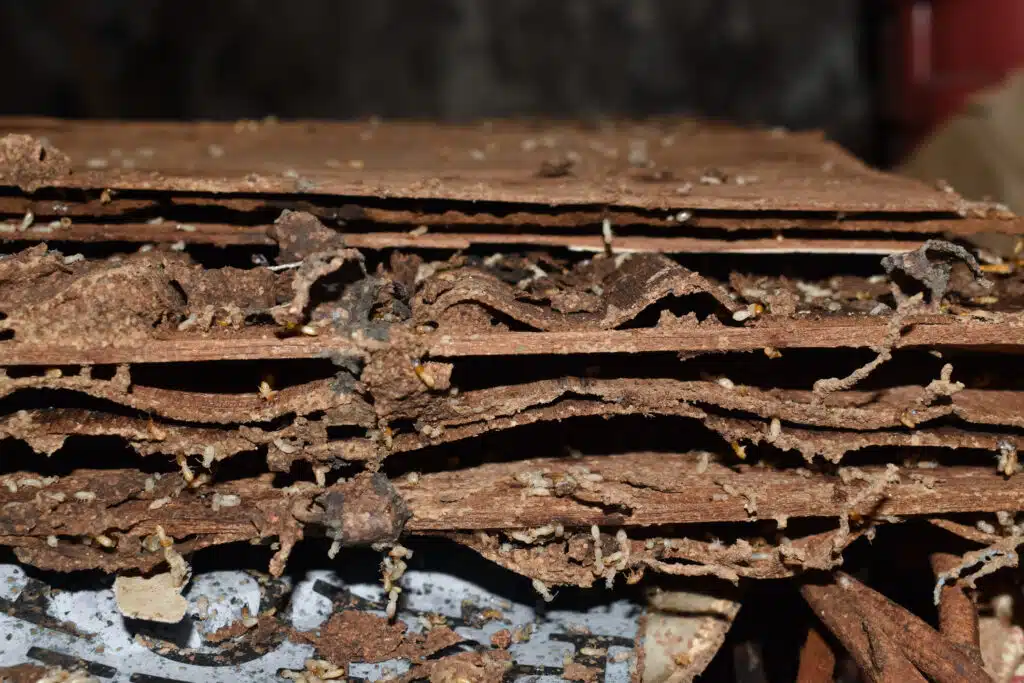
Termite Damage vs. Carpenter Ant Damage
Carpenter ants don’t eat wood; they carve smooth, clean galleries and push out coarse sawdust mixed with insect parts. Termite galleries look rough and are packed with soil. If you see sawdust piles, read our carpenter ant guide.
Health & Property Risks
Termites don’t bite, sting, or spread disease. The risk is to your home. They can weaken floor joists, sill plates, subfloors, and wall framing, and the damage is often hidden until repairs are extensive. Termite damage is generally excluded from homeowners insurance, and it can come up during a home sale inspection.
How to Prevent Termites
- Control moisture: Fix leaks, keep gutters clear, and point downspouts away from the foundation.
- Dry out the crawl space: Damp crawl spaces attract termites. Learn about crawl space encapsulation.
- Break wood-to-soil contact: Keep siding, trim, and deck posts off the ground.
- Store wood away from the house: Keep firewood and lumber well away from the foundation and off the ground.
- Pull mulch back: Leave a few inches of bare space between mulch and the foundation.
- Inspect yearly: An annual professional inspection catches activity before it becomes damage.
How Termites Are Treated
Professional treatment targets the colony, not just the termites you can see. Depending on the home and the activity, a technician may apply a liquid treatment to the soil around and beneath the foundation, install a baiting system, or combine the two, then monitor over time. Store-bought sprays can’t reach an underground colony or create continuous protection around a foundation.
Learn more about our termite control services, or schedule a free inspection.
Frequently Asked Questions
What kind of termites are in Tennessee?
Subterranean termites, mainly the eastern subterranean termite, cause nearly all termite damage in Tennessee. Drywood and dampwood termites are rare here, and Formosan termites are not a common problem in Middle Tennessee.
How can I tell if I have termites?
Look for mud tubes on foundation walls, winged swarmers or shed wings indoors, and wood that sounds hollow or has soil-packed galleries. Bubbling paint and sticking doors can also be signs.
Are flying termites a sign of an infestation?
Swarmers inside your home almost always mean a colony is established in or under the structure. Swarmers outdoors show that colonies are active nearby.
Does homeowners insurance cover termite damage?
Generally, no. Most policies treat termite damage as preventable, which is why annual inspections and ongoing protection matter.
How often should I get a termite inspection?
Once a year is the standard recommendation in Tennessee, and more often if you’ve had termites before or have a damp crawl space.
Schedule a Free Inspection
If you’ve seen swarmers, mud tubes, or damaged wood, have it checked now. U.S. Pest Protection’s licensed technicians will inspect your home at no cost. Serving Nashville and Middle Tennessee. See our termite control services.A real TN person answers. No call center.
Free inspections across Middle Tennessee from your local, family-owned team.
